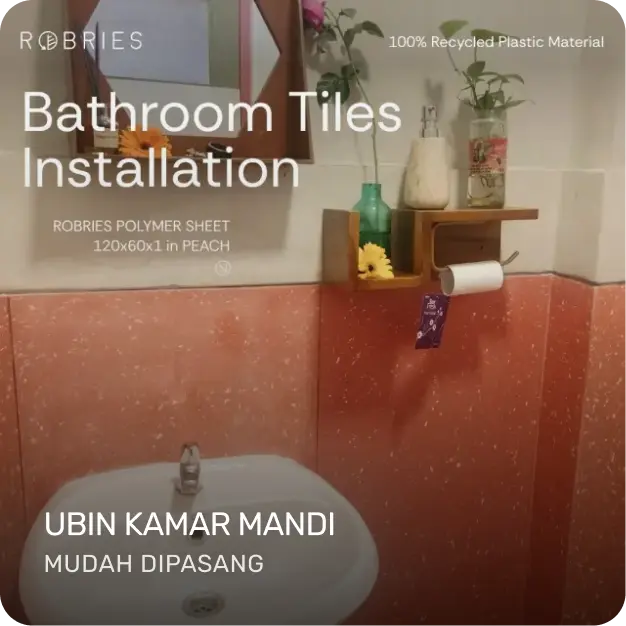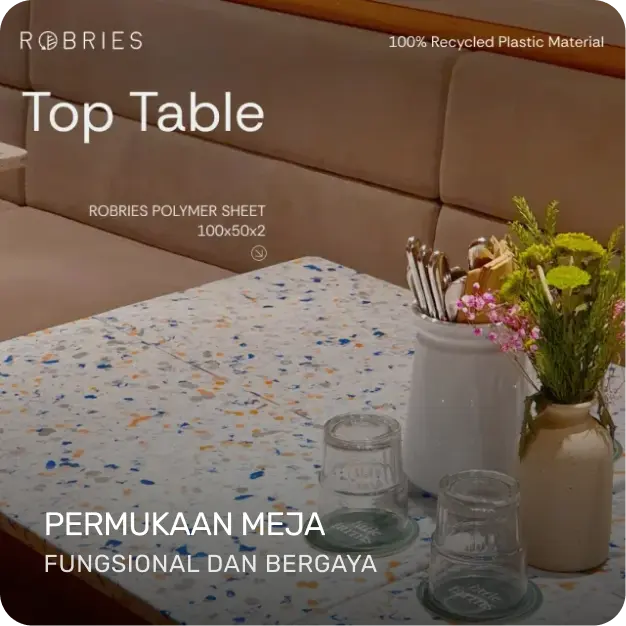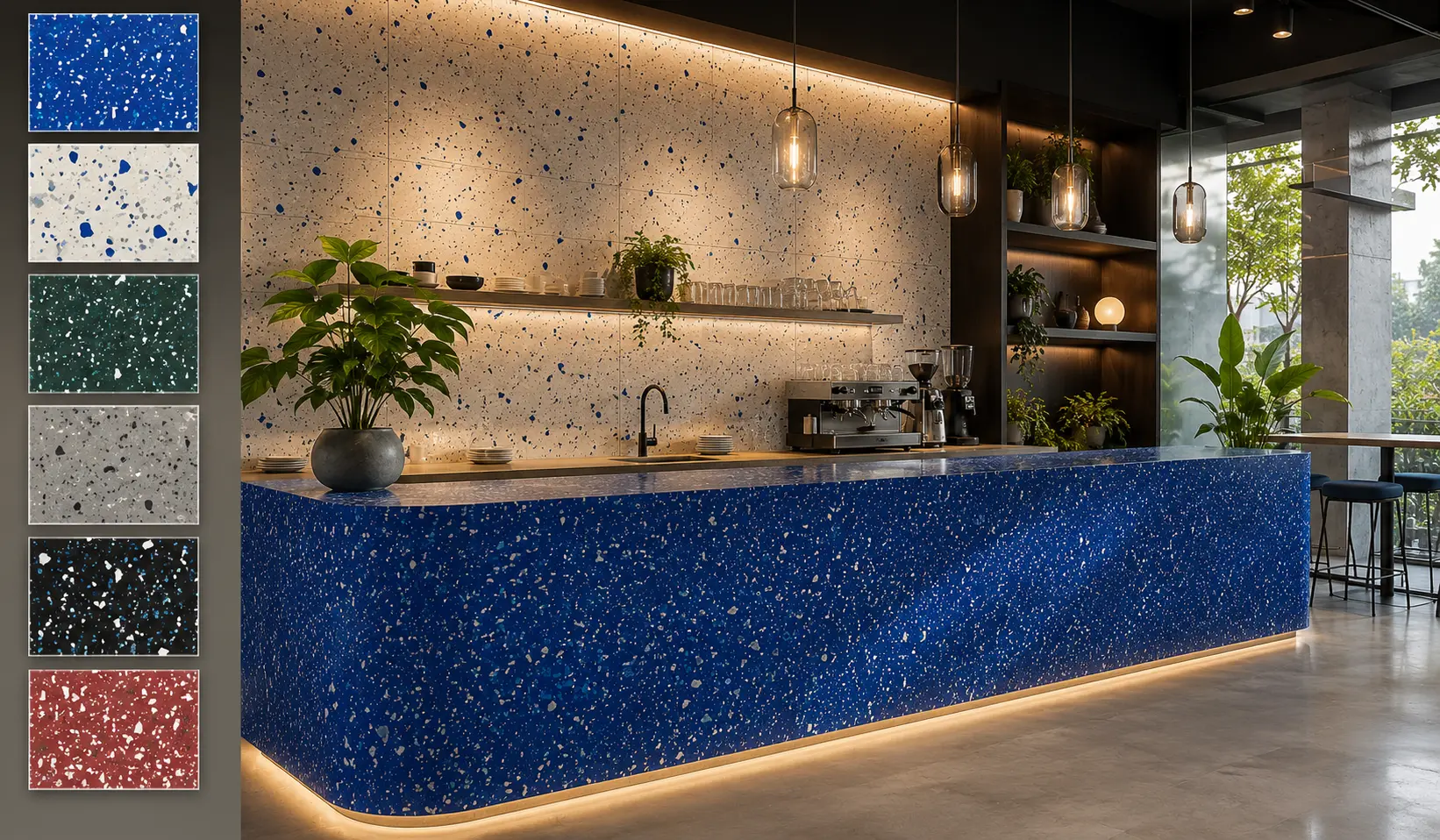

Recycled plastic sheet (custom) is made in flexible sizes, colors, and thicknesses, then cut and finished for various commercial interior elements. Its distinctive visual character (marbled, terrazzo, mosaic) suits tabletops, decorative wall panels, and custom elements (counter bars, display racks). It resists moisture, is strong, and easy to maintain. Robries produces spec-ready sheets in three standard sizes plus custom for commercial projects.
The material that shapes commercial interiors
In commercial interiors, material defines a space’s character — from aesthetics to durability and environmental impact. Recycled plastic surfaces draw growing attention: produced by processing waste into solid sheets, they are now used in cafes, offices, retail, and public spaces.
Custom sheets and their spec flexibility
Material can be produced in various sizes, colors, and visual characters — often called custom recycled plastic sheets. It can then be processed by cutting, shaping, and specific finishing for various interior products. Robries offers three standard sizes (95×40, 100×50, 120×60 cm) with 1-2 cm thickness options.
The organic pattern that draws the eye
Unlike uniform industrial materials, recycled plastic yields organic patterns: marbled, terrazzo, random color blends, mosaic motifs. Decorative panels often become a visual focal point rather than a mere supporting element.
What it is used for in commercial spaces
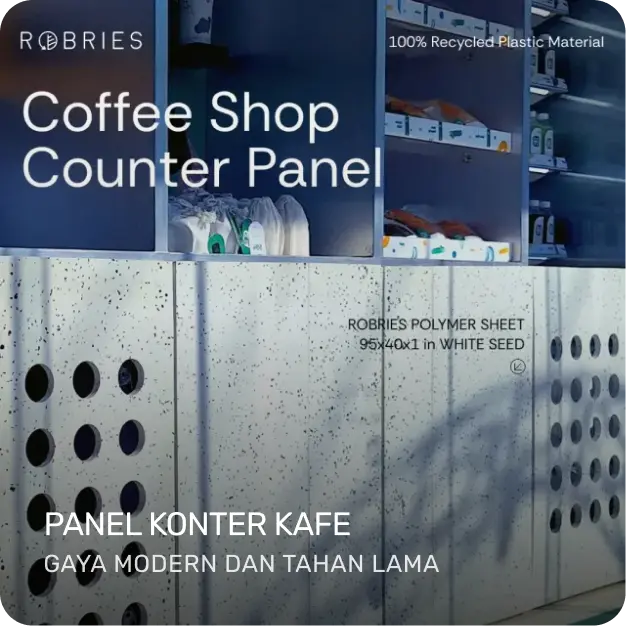
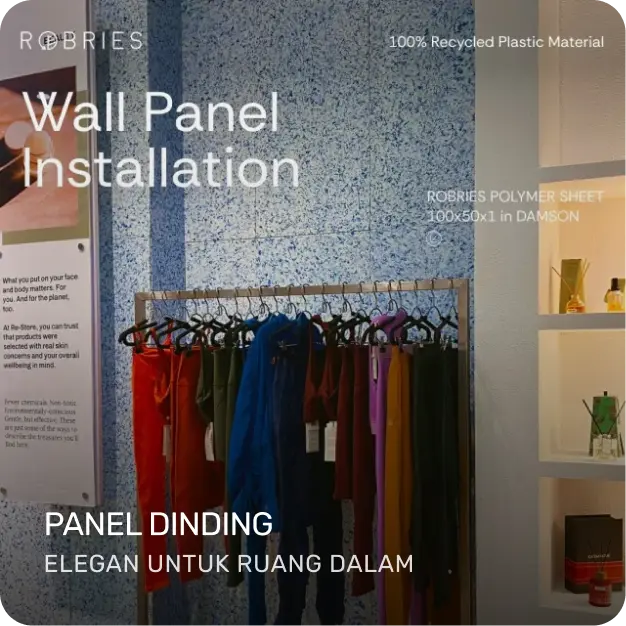
Tabletops with an expressive look for cafes and coworking; decorative wall panels for feature walls, reception, lounges, and partitions; and custom elements like display racks, counter bars, and communal tables. Produced in various thicknesses to suit design needs.
Sheet size, thickness, and weight
Robries produces sheets in three standard sizes: 95×40 cm (actual 94.7×39.7), 100×50 cm (actual 99.7×49.7), and 120×60 cm (actual 119.7×59.7). Weight varies by thickness — for example the 120×60 cm size comes in 1 cm (approx 11 kg), 1.5 cm (approx 16 kg), and 2 cm (approx 19 kg). Understanding these specs early helps designers plan sheet count, structural load, and mounting method accurately.
Edge finishing and processing options
After being cut to dimension, sheets can go through various finishing depending on the application. Edges can be smoothed for frequently touched tabletops or left with a certain cut character for an industrial look. Holes for legs, cables, or joints can be drilled per the shop drawing. This post-production flexibility lets a single material serve many different applications within one project.
From sample to project production
A typical workflow: order a sample to assess color and texture, then finalize specifications (size, thickness, quantity, color) based on the shop drawing. For custom cutting, lead time is typically 2-4 weeks depending on volume. Robries provides a complete technical spec sheet so contractors can process the material with common tools, no special equipment needed. A free physical sample ships to the studio within 3 working days.
Before ordering: what to note
As a practical summary: Custom recycled plastic sheets come in three standard sizes with 1-2 cm thickness, cut and finished for tables, panels, and commercial interior elements. To validate whether the material fits your project needs, the most effective step is to assess it directly — Robries provides a free physical sample plus a technical spec sheet delivered to your studio or project site within 3 working days, with no purchase obligation. With a sample in hand, design and procurement teams can evaluate color, texture, weight, and dimensional fit before making a budget decision. An early discussion of volume, dimensions, and timeline also helps the material team prepare an accurate estimate and maintain consistency across orders.
Full specs: from size to weight
Robries custom recycled plastic sheets come in three standard sizes with precise actual dimensions: 95×40 cm (actual 94.7×39.7), 100×50 cm (actual 99.7×49.7), and 120×60 cm (actual 119.7×59.7). Three thickness options are available—1 cm, 1.5 cm, and 2 cm—with weight varying by size and thickness; for example a 120×60 cm sheet ranges from about 11 kg (1 cm) to about 19 kg (2 cm). Understanding these specs from the design stage helps calculate sheet count, structural load, and mounting method accurately—important for project planning and cost estimation.
How to process and join the material
After being cut to dimension, sheets can go through various finishing depending on the application. Edges can be smoothed for frequently touched tabletops or left with a certain cut character for an industrial look. Holes for legs, cables, or joints can be drilled per the shop drawing. The material can be cut with a circular saw, router, or jigsaw; joined with a drill and nail gun; bonded with epoxy or contact adhesive; and bent with a heat gun at around 60°C for curved elements. What to avoid is laser cutting—excess heat melts the material. This flexibility lets a single material serve many applications within one project.
Custom sheets straight from Robries
Robries produces recycled plastic sheets in three standard sizes (95×40, 100×50, 120×60 cm) with 1-2 cm thickness, plus custom options to suit project needs. The material can be cut and finished for tabletops, wall panels, and commercial interior elements. A complete technical spec sheet is available for contractors, and a free physical sample can ship to your studio.
Yes. Sheets can be produced custom in size, color, and thickness. Robries offers three standard sizes (95×40, 100×50, 120×60 cm) with 1-2 cm thickness options.
Tabletops, decorative wall panels (feature walls, reception, partitions), and custom elements such as counter bars and display racks.
Yes. The material resists moisture, is sufficiently strong, and easy to maintain — suitable for high-use spaces.
Three standard sizes: 95×40, 100×50, and 120×60 cm, with 1, 1.5, and 2 cm thickness options. Custom sizes and thicknesses can be discussed for specific project needs.
Yes. Edges can be smoothed for frequently touched surfaces, and holes for legs, cables, or joints can be drilled per the shop drawing using common tools.